Guide
Can blurred text in a screenshot be recovered?
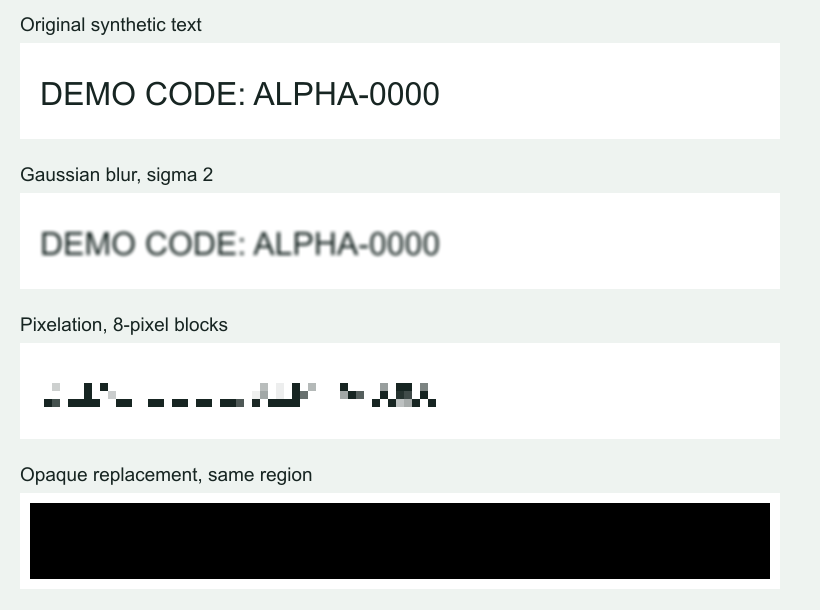
Sometimes text remains readable or distinguishable after blur or pixelation, but there is no universal recovery guarantee. The result depends on the transformation, original lettering and prior knowledge. Our small example experiment shows why blur is a weak removal boundary.
Separate recovery from a plausible guess
Reading visible letters, matching one of a few known values and recovering arbitrary unknown text are different tasks. An AI-generated guess is not evidence of the original wording.
For privacy, the relevant question is whether enough information remains to identify or distinguish the value. You do not need a perfect general decoder for a weakly hidden value to be a problem.
The controlled experiment
We rendered four invented codes with the same font, size and position. The target was DEMO CODE: ALPHA-0000. Each candidate was blurred with Gaussian sigma 2 and compared to the target across its RGB samples.
The correct candidate had a mean squared difference of 0. The other three had differences of approximately 300.49, 353.86 and 278.80. With this known candidate set and these exact settings, the blurred samples remained distinguishable.
What the result does not prove
This is candidate matching with known rendering parameters. It is not an OCR benchmark, a general deblurring method or an attempt to recover anyone’s private information.
A different font, alignment, compression level or blur can change the result. The experiment also does not establish the safety or failure of another product’s implementation.
Pixelation has documented attacks too
Bishop Fox’s public Unredacter research demonstrates pixelation attacks while documenting important assumptions about matching font and rendering. Those assumptions are a reason to state limits clearly, not a reason to treat pixelation as information deletion.
Remove the information before sharing
Use a complete opaque region in a newly encoded image, inspect the exported file and review all remaining context. Do not use a successful OCR failure as proof that a secret is gone.
If a real credential was already shared, replace or revoke it through its provider. Editing a later screenshot does not invalidate the credential.